
Standard Uranium completes the first ExoSphere Multiphysics programme in the Southwestern Athabasca Basin
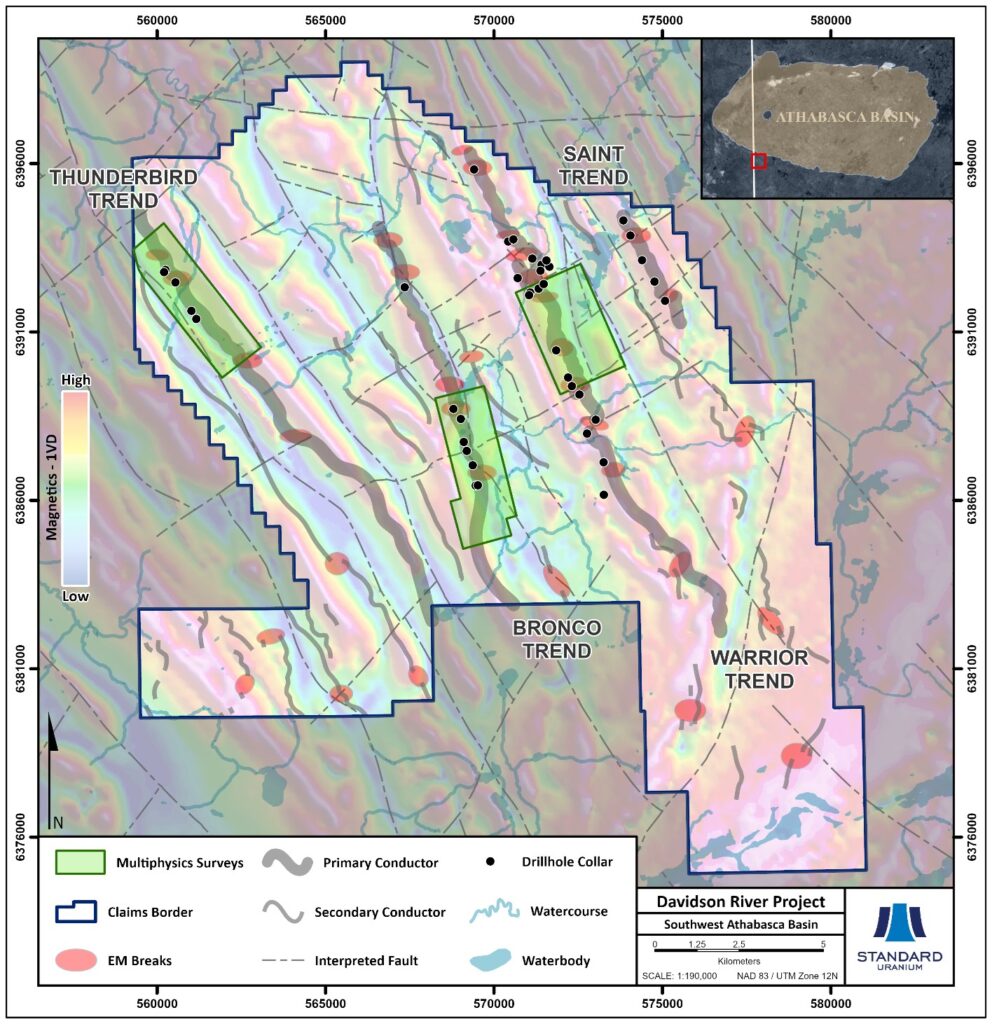
Standard Uranium Ltd. has announced the completion of three ExoSphere Multiphysics survey grids on its flagship Davidson River in the southwest Athabasca Basin region, northern Saskatchewan.
“We are very pleased to be the first to implement the Exosphere Multiphysics technology in the southwest Athabasca Basin on our flagship Davidson River project, and we are excited about the results we’re seeing,” Sean Hillacre, President & VP Exploration of Standard Uranium commented. “With the new data in hand from these surveys, the technical team and I are extremely eager to continue developing our drill targets for this summer. Getting the drills back in the ground at Davidson has been the goal we’ve been working towards for the last three years and 2025 is shaping up to be a transformative year for Standard.”
Davidson River covers 30,737 hectares of prime exploration real estate in the Southwest Athabasca Uranium District, highly prospective for basement-hosted uranium deposits along trend from high-grade* uranium deposits under development (Figure 2).
From May 26 to July 8, 2025, the Company and Fleet Space completed the first-ever ExoSphere Multiphysics survey grids in the uranium-rich southwest Athabasca Basin region. Multiphysics surveys collected three types of geophysical data (ANT, HVSR, and Gravity) over three (Warrior, Bronco, and Thunderbird) of the four major conductive corridors on the Project. The surveys will provide critical targeting layers in the form of 3D ANT-HVSR shear velocity models and custom inversion models for subsurface density, leveraging both passive seismic and ground gravity datasets as inputs.
Using Fleet Space’s proprietary Cover Depth analysis from the ANT data in combination with the ground gravity data, Fleet Space will compute and provide a cover-corrected gravity dataset which will significantly upgrade target areas at Davidson River through imaging of density anomalies in the basement rock. These surveys will be the first of their kind in the SW Athabasca Basin uranium district and marks a significant step towards discovery on the Davidson River.
Density anomalies in the basement rock coinciding with known graphitic conductors are often indicative of potential zones of hydrothermal alteration of host rocks associated with uranium mineralisation events. Drill targeting with this strategy has been proven through the discovery of world-class uranium deposits in the SW Athabasca Basin and will upgrade targets across the Project.
Following post-survey data analysis and integration, the Company plans to execute a diamond drill programme to begin testing the highest priority targets across all three surveyed conductor corridors. Drilling is planned to be completed this summer, marking the first drill programme on the Project since 2022. Positive results from previous drill campaigns will be integrated into drill targeting with the newly acquired Multiphysics data. High confidence datasets from all three survey grids have now been received and are in the process of joint inversion and modelling to refine drill targets for a summer drill programme planned for August-September 2025.
To find out what else is going on in the mining industry, click here!