Perpetua Resources Corp. (Nasdaq: PPTA / TSX: PPTA) is pleased to report drilling results and provide an update on its 2026 exploration program in Valley County, Idaho. The exploration plan was approved by the U.S. Forest Service in 2025.
“Our focus is on drilling areas that align with our currently planned mining sequence with potential to directly add value,” said Jon Cherry, President and CEO of Perpetua. “Our priority is testing higher-grade gold and antimony targets within our three permitted pits that could supplement our existing Stibnite Gold Project (the “Project”) mine plan with the aim of sustaining or exceeding our estimated annual average production level of 463,000 gold ounces beyond our first four years of production.
“We have also identified gold and antimony exploration targets with the potential to allow for extensions of the existing permitted pits within the Project and are evaluating opportunities to expand our overall resource base beyond the existing Project scope. This includes identifying potential sources of tungsten that could enhance the value of Perpetua’s broader land package. These targets are based on previous drilling, historic mining activities and recently defined prospects across the broader, highly prospective land package. Any activity outside the scope of the currently permitted project may require additional regulatory review.”
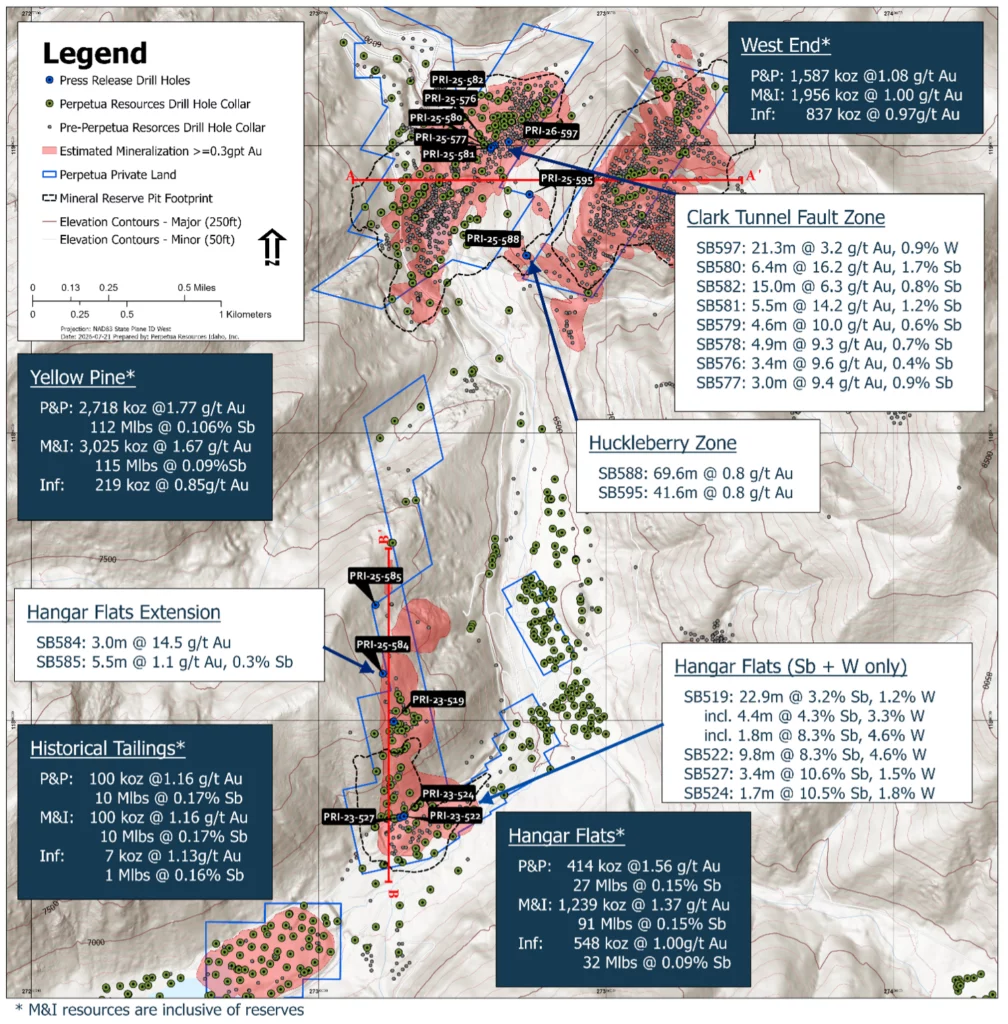
Recent drilling between the currently permitted Yellow Pine and West End reserve pits continues to reveal compelling new mineralization, including multiple high-grade gold intervals and a new gold-tungsten discovery. Significant high-grade gold intercepts, including a gold-tungsten intercept, have been identified in the Clark Tunnel Fault Zone (“CTFZ”) located along the southeastern edge of the proposed Yellow Pine pit. Additional occurrences of scheelite, a tungsten-bearing mineral, have been observed in ongoing drilling in the CTFZ. In addition, widely spaced drilling and surface sampling at the Huckleberry Fault Zone (“HFZ”) returned broad intervals of gold mineralization.
Lying immediately adjacent to the Yellow Pine reserve pit limits, the HFZ spans over 100 meters in width and has been traced across 0.5km of strike length, with historic data indicating higher-grade lenses can occur. At the Hangar Flats deposit, drilling at the NDMEA zone encountered additional high-grade gold, while critical mineral-focused drilling at Hangar Flats returned significant antimony-tungsten intercepts. These results collectively demonstrate further opportunities to grow and unlock the 3.1 million ounces of indicated and inferred gold resources and 99.8 million pounds of antimony resources that are located outside current reserves.
Exploration drilling is currently underway with 4 rigs and approximately 5,800 meters of new drilling complete to date. During the first half of 2026, Perpetua became aware of U.S. government-sponsored initiatives focused on tungsten. Based on the historical production of both antimony and tungsten at Stibnite and given that recent drilling confirmed areas in the Hangar Flats deposit host a combination of high-grade antimony (5-13%) and tungsten (1-6%) at varying widths of 1-10 meters, the Company has submitted proposals seeking U.S. grant funding to undertake drilling, sampling, metallurgical analysis, and resource evaluation. While there can be no assurance that the Company will obtain such grant funding or that economically accessible quantities of tungsten will be identified, Perpetua believes its broader claim package is uniquely positioned to help the U.S. government potentially secure a second critical mineral, in addition to antimony, from the Stibnite mining district. Any tungsten development will require separate public & environmental review and permitting outside the scope of the currently permitted project.
In its grant proposal, Perpetua proposed to embark on a program focused on drilling and metallurgical sampling beneath the Hangar Flats pit. This work would serve a dual strategic purpose of enabling drilling to test known high-grade antimony-tungsten mineralization at depth while simultaneously providing additional testing of significant gold and antimony resources previously identified but not included in Perpetua’s current mine plan. Previously reported drill holes indicate the promising potential for recovery of tungsten near areas in the existing mine plan.
Perpetua Resources Corp. (Nasdaq: PPTA / TSX: PPTA) is pleased to report drilling results and provide an update on its 2026 exploration program in Valley County, Idaho. The exploration plan was approved by the U.S. Forest Service in 2025.
“Our focus is on drilling areas that align with our currently planned mining sequence with potential to directly add value,” said Jon Cherry, President and CEO of Perpetua. “Our priority is testing higher-grade gold and antimony targets within our three permitted pits that could supplement our existing Stibnite Gold Project (the “Project”) mine plan with the aim of sustaining or exceeding our estimated annual average production level of 463,000 gold ounces beyond our first four years of production.
“We have also identified gold and antimony exploration targets with the potential to allow for extensions of the existing permitted pits within the Project and are evaluating opportunities to expand our overall resource base beyond the existing Project scope. This includes identifying potential sources of tungsten that could enhance the value of Perpetua’s broader land package. These targets are based on previous drilling, historic mining activities and recently defined prospects across the broader, highly prospective land package. Any activity outside the scope of the currently permitted project may require additional regulatory review.”
Recent drilling between the currently permitted Yellow Pine and West End reserve pits continues to reveal compelling new mineralization, including multiple high-grade gold intervals and a new gold-tungsten discovery. Significant high-grade gold intercepts, including a gold-tungsten intercept, have been identified in the Clark Tunnel Fault Zone (“CTFZ”) located along the southeastern edge of the proposed Yellow Pine pit. Additional occurrences of scheelite, a tungsten-bearing mineral, have been observed in ongoing drilling in the CTFZ. In addition, widely spaced drilling and surface sampling at the Huckleberry Fault Zone (“HFZ”) returned broad intervals of gold mineralization.
Lying immediately adjacent to the Yellow Pine reserve pit limits, the HFZ spans over 100 meters in width and has been traced across 0.5km of strike length, with historic data indicating higher-grade lenses can occur. At the Hangar Flats deposit, drilling at the NDMEA zone encountered additional high-grade gold, while critical mineral-focused drilling at Hangar Flats returned significant antimony-tungsten intercepts. These results collectively demonstrate further opportunities to grow and unlock the 3.1 million ounces of indicated and inferred gold resources and 99.8 million pounds of antimony resources that are located outside current reserves.
Exploration drilling is currently underway with 4 rigs and approximately 5,800 meters of new drilling complete to date. During the first half of 2026, Perpetua became aware of U.S. government-sponsored initiatives focused on tungsten. Based on the historical production of both antimony and tungsten at Stibnite and given that recent drilling confirmed areas in the Hangar Flats deposit host a combination of high-grade antimony (5-13%) and tungsten (1-6%) at varying widths of 1-10 meters, the Company has submitted proposals seeking U.S. grant funding to undertake drilling, sampling, metallurgical analysis, and resource evaluation. While there can be no assurance that the Company will obtain such grant funding or that economically accessible quantities of tungsten will be identified, Perpetua believes its broader claim package is uniquely positioned to help the U.S. government potentially secure a second critical mineral, in addition to antimony, from the Stibnite mining district. Any tungsten development will require separate public & environmental review and permitting outside the scope of the currently permitted project.
In its grant proposal, Perpetua proposed to embark on a program focused on drilling and metallurgical sampling beneath the Hangar Flats pit. This work would serve a dual strategic purpose of enabling drilling to test known high-grade antimony-tungsten mineralization at depth while simultaneously providing additional testing of significant gold and antimony resources previously identified but not included in Perpetua’s current mine plan. Previously reported drill holes indicate the promising potential for recovery of tungsten near areas in the existing mine plan.
To find out what else is going on in the mining industry, click here!