Geologists are skilled time travellers because they read the traces of millions of years of Earth’s history. Nevertheless, many of these professionals would like to actually travel back in time 100 years just once. Geologically, that may be the blink of an eye, but economically, the difference is enormous: 100 years ago, most of the major discoveries, some of which still cover our need for metals to this day, were still in the future. These simple, large finds are a thing of the past.
More recent discoveries tend to be not only smaller, but also deeper, and on top of that, the average metal content is decreasing. So, have all the big targets already been found long ago? Isn’t there something new that is large, near the surface, and high-grade, and has been overlooked, whether for geological or political reasons? And, one might add, that doesn’t already belong to a Chinese corporation?
But, exactly such targets exist, in a remote corner of the South Pacific. This is the thesis of the young Canadian company Sankamap Metals. Sankamap CEO John Florek, looking back at the projects he has secured in the last three years on the Solomon Islands, southeast of Papua New Guinea, said it feels like 1930, when the big, simple discoveries were still openly visible.
And from Florek’s mouth, this statement carries weight, because he held senior positions at Barrick Gold, BHP, Teck and Detour Gold, sits on the supervisory board of McEwen Mining and has ensured that McEwen itself is a shareholder in Sankamap. Florek and the entire Sankamap management team are well-connected in the industry and have many years of experience with international exploration projects. Chairman John Williamson, founder of the well-known Metals Group, has already raised over CAD 1 billion in capital for exploration companies in his career. Donald Marahare, a licensed attorney at the High Court of the Solomon Islands, is on board as legal counsel. Mining engineer Arthur Hannet also comes from the region and worked for Placer, Barrick, Glencore and Agnico Eagle for a long time. He is also the son of the former founder of the island nation of Bougainville within the archipelago.
In fact, Sankamap’s projects are located on one of the last “Last Frontiers” of exploration. The Solomon Islands are part of the so-called “Ring of Fire”, a vast volcanic belt that spans the entire Pacific. The Solomon Islands are usually mentioned in the news in connection with the consequences of climate change and the rise in sea levels. Probably also for this reason, there is a great political openness to explore the mineral resources of the archipelago, because that would secure a future source of income. Sankamap ensures that local forces are employed and trained in the future in all work.
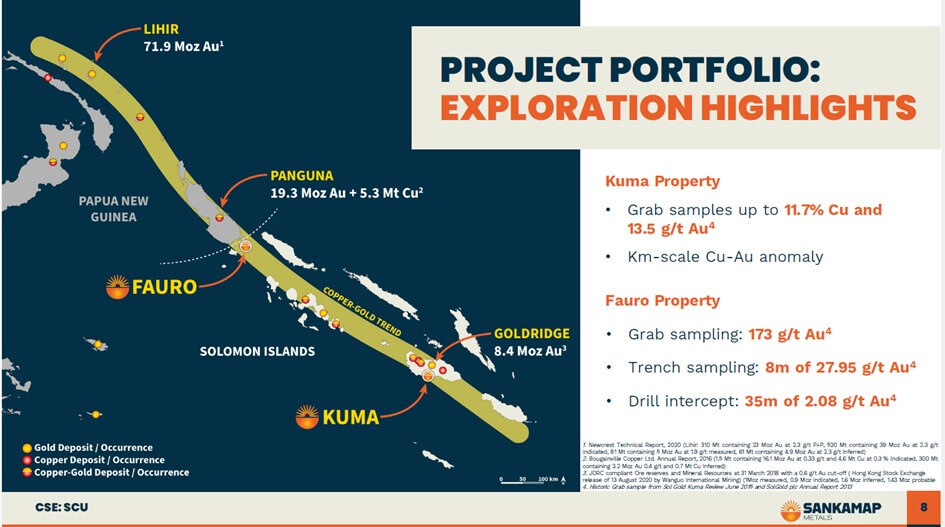
The Kuma properties, a geologically young gold-copper porphyry system, and Fauro – also geologically young and also a gold and copper project, lie on the same tectonic structure as some of the most productive mines on earth. Newmont’s Lihir project in Papua New Guinea. With over 70 million ounces of gold, Lihir is even the largest gold mine in the world! The geological engine of all deposits in the region (including the Panguna project on Bougainville Island, which contains over 19.3 million ounces of gold and around 5.1 million tons of copper) is the subduction zone between the Australian and Pacific plates.
The name Bougainville is reminiscent of the French explorer of the island, who explored the South Pacific in the last third of the 18th century – at the same time as James Cook. Anyone who wants to is welcome to think about this historical dimension at Sankamap. It forms the conceptual link that connects the geological exploration of the last “white spots” on the map today with the pioneering spirit of that time.
The Kuma project, located around 37 kilometers southeast of the capital Honiara, covers 43 square kilometers and shows clear signs of a large-volume copper-gold porphyry system. Historical samples yielded up to 11.7% Cu and 13.5 g/t Au – exceptional values for an untested target area. Geophysical surveys showed kilometer-wide magnetic anomalies and molybdenum signatures – typical features of a deeply rooted hydrothermal system.
“Kuma has all the characteristics of a porphyry copper-gold system of regional importance – but so far completely untested by drilling,” explained John Florek.
One of the routine methods of experienced exploration geologists is to search along streams for traces of metal. They often gradually feel their way to the source of the mineralisation based on tiny concentrations in the range of ppb (parts per billion).
In the case of Kuma, the situation is different: here the team needed neither a sieve nor a magnifying glass. Along the riverbed there are man-sized, clearly mineralised rock fragments – a visible sign that the source of the mineralisation cannot be far away.
Particularly exciting: Upstream, the metal-containing boulders end abruptly. The geologists conclude that the fragments must come from a specific section of the river valley – exactly where Sankamap has carried out modern geophysical tests. These showed an almost textbook signature of a porphyry system, probably only a few million years old.
The age is crucial: In young porphyry systems, the so-called lithocap – the near-surface rock cap altered by hydrothermal processes – is often still intact. In older deposits, such as in South America, this easily erodible zone has usually been removed long ago and the search for the center of the porphyry system is correspondingly more difficult.
At Kuma, the lithocap appears to be perfectly preserved. Initial sampling from this area already shows increased gold and copper contents, and CEO John Florek is convinced that it could be one of the last intact, untested lithocaps in the world. “That’s what makes Kuma so unique – we are seeing a porphyry system in its formation phase, so to speak,” explains Florek.
The second project, Fauro, is located on the Shortland Islands in the west of the Solomon Islands. The geology is strikingly reminiscent of the structure of the Lihir mine – a collapsed volcano in which hydrothermal solutions have left rich gold veins. Historical work brought spectacular results to light: grab samples up to 173 g/t Au, drill sections over 35 m @ 2.08 g/t Au and trenches with 8 m @ 27.95 g/t Au. More recent investigations from 2025 confirm this potential: samples with up to 19.25 g/t Au and 4% Cu indicate that a porphyry system continues below the epithermal structures.
The team around CEO John Florek combines decades of experience with a spirit of discovery and their own financial commitment. Before the completion of the latest capital round of CAD 4.7 million, the management held almost half of the shares. This is not only a clear commitment to long-term value creation, but a sign that the share is still at the beginning of its development. Sales are still relatively weak, but this can easily change with upcoming activity. The latest capital increase was completed at CAD 0.22 per unit (consisting of one share and half a warrant). The warrants are equipped with an exercise price of CAD 0.40 and could provide the company with a further CAD 4.35 million if fully exercised within two years.
Based on a share price of currently CAD 0.275, a market capitalisation of around CAD 17.8 million results with around 61 million shares outstanding, of which more than CAD 4 million is recorded as cash on the balance sheet. This gives Sankamap a solid financial basis for the upcoming drilling programmes.
The coming months will be decisive. The first drilling is scheduled to begin at Kuma at the end of the fourth quarter of 2025 or in the first quarter of 2026, as soon as the ongoing geophysical programmes are completed. At the same time, Fauro will be further developed through mapping and new analyses. A second drilling programme is planned here for 2026.
To find out what else is going on in the mining industry, click here!