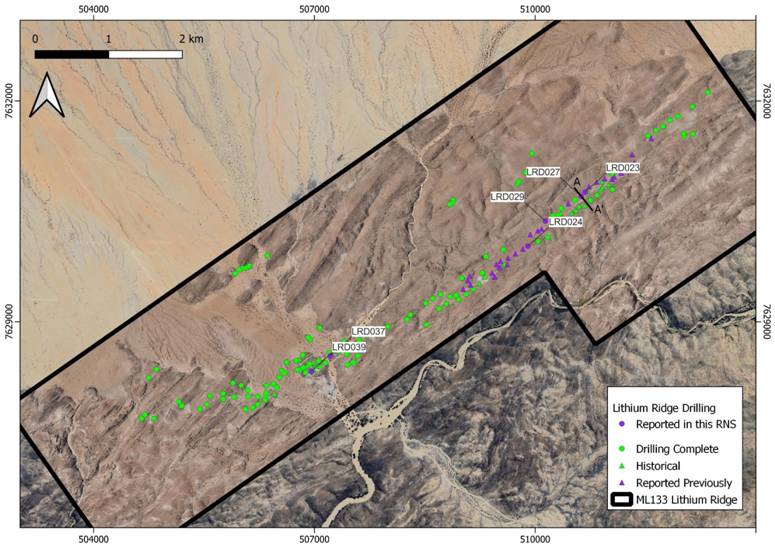
Andrada Mining Limited (AIM: ATM, OTCQB: ATMTF), a tin producer with a portfolio of critical minerals mining and exploration assets in Namibia, is pleased to announce the third batch of results for an additional six holes of diamond drilling at Lithium Ridge Project (LR) The additional six holes show the presence of consistent high-grade lithium mineralisation from surface. Following the completion of drilling, the exploration team continues to prioritise logging and sampling activities to expedite sample delivery.
“We continue to receive exciting results from the recently completed drill programme at Lithium Ridge, conducted with our partners SQM,” Anthony Viljoen, Chief Executive Officer, commented. “Intersection grades up to 3.46% Li2O near-surface, demonstrate exceptional quality and scale, reaffirming our shared conviction in the potential of the asset.
“Having strategically expanded our drilling footprint to fast-track the definition of the geological system’s true boundary and economic value, these results further endorse our course of action. The additional presence of significant associated tin and tantalum mineralisation adds a highly attractive multi-commodity dimension to the potential project economic profile. Lithium Ridge is rapidly establishing itself as a standout, project within Andrada’s critical minerals portfolio in Namibia.”
The results refer to an additional six drill holes and are reported as ‘Whole Intersections’ in Table 1, representing pegmatite intersections from the top to the bottom contact. Where these intersections contain schistose xenoliths, the reported grades reflect the metal content of the pegmatite only, excluding the schistose intervals. Intersections reported as ‘including’ represent selected higher-grade zones within the total pegmatite intersection. Spodumene has been visually identified as the primary lithium-bearing mineral by the project geological team. Tin and tantalum grades have also been highlighted as potential by-product revenue streams.
The boreholes were drilled at inclined angles to the horizontal and, accordingly, the reported intersections are considered to represent apparent widths rather than true thicknesses. Pegmatite intersections that did not meet at least one of the following metal content cut-off criteria (>0.25% Li₂O, >0.1% Sn or >99ppm Ta) have not been reported as they are currently regarded as economically insignificant. Downhole orientation surveys were conducted at regular intervals for each hole as the drilling was advancing and surveyed in totality after drilling was completed. The surveys were conducted using a magnetic deviation probe that collected readings at two metre intervals whereas collar locations were surveyed using a handheld GPS. The Stage 1 drill programme was expanded by 18% to 16 525 metres of orientated diamond core across the license area and was completed in May 2026. (See announcements dated 5 May and 27 May 2026).
Individual drill holes were geologically and structurally logged prior to being cut and sampled as quarter core. The sampling programme followed geological contacts while simultaneously maintaining consistency in data and sample representativity. Sample lengths ranged from 25 cm to 125 cm, where practicable. The samples were submitted to independent and certified laboratories, namely SA Labs Ithuba for pulverisation and homogenisation, and the pulps were subsequently dispatched to UIS Analytical Services for chemical analysis. Lithium and other related major elements were analysed using sodium peroxide fusion with ICP-OES, while tin, tantalum and other trace elements were analysed using lithium borate fusion with ICP-MS. No top cut was applied in calculating the weighted average grades for mineralised intersections within the pegmatites.
To find out what else is going on in the mining industry, click here!