Perpetua Resources Corp. (Nasdaq: PPTA / TSX: PPTA) (“Perpetua Resources,” “Perpetua,” or the “Company”) provided an update on exploration activities at the Company’s Stibnite Gold Project (the “Project”) in central Idaho. The 2026 Exploration Drilling Program is now complete with over 16,000 meters of core drilling across the Project. The program’s objectives included upgrading in-pit and near-pit inferred resources, extending mineralization along strike, testing key underground targets, and following up on discoveries from the 2025-2026 drill program.
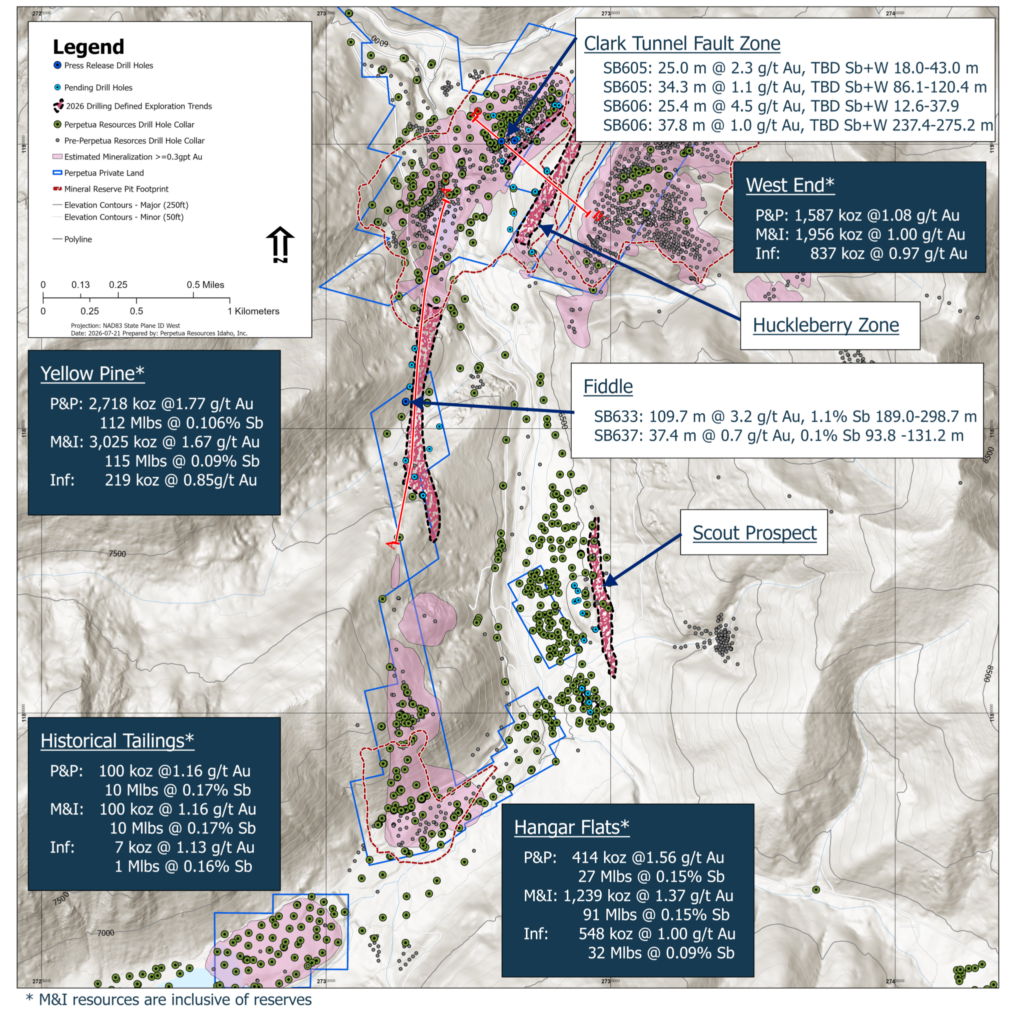
Initial assays from the Fiddle target returned 109.7 meters grading 3.2 g/t gold, 1.1% antimony in hole SB633, beginning at 189 meters downhole. SB633 represents one of the broadest continuous intervals of gold and antimony mineralization returned to date from Stibnite while also exhibiting grades more than double the Project’s life-of-mine average. Additional assays came from 3 holes: SB637, which extended mineralization 110 meters to the north, and SB643 and SB646, which were drilled from a pad to the north of SB633. An additional 21 holes were drilled along strike of SB633. Two subsequent holes, SB665 and SB671, were drilled to the south and are awaiting assay. Core logging identified both holes as having similar style mineralization to hole SB633, including abundant stibnite and sulfides within the mineralized zones.
Follow-up drilling from the Clark Tunnel Fault Zone (“CTFZ”) continued to demonstrate near-surface, high grades including 25.4 meters of 4.5 g/t gold from 13 meters downhole (SB606) and 25.0 meters of 2.3 g/t gold from 18 meters downhole (SB605). Antimony and tungsten assay results for these holes are currently pending. Recently identified high-grade Au-Sb mineralization in the CTFZ is partly within the permitted Yellow Pine pit and has the potential to supplement the existing production profile, with results detailed further below.
“Given their close proximity to the permitted Yellow Pine pit, Fiddle and the CTFZ were prioritized as key targets for the 2026 exploration program,” said Jon Cherry, President and CEO of Perpetua Resources. “At Fiddle, our initial hole returned broad, continuous mineralization at significant gold and antimony grades which confirm it as an important new discovery. Meanwhile, drilling continues to reinforce the CTFZ as a near-surface, high-grade target on the eastern extent of the Yellow Pine pit. We’re pleased with the results from our recent drilling which align with our objectives of expanding our currently defined resource base and extending our compelling production profile.”
Fiddle’s discovery hole, SB633, returned 109.7 meters grading 3.2 g/t gold and 1.1% antimony, among the most significant mineralized intercepts encountered at the Project to date, underscoring the importance of the discovery. Located approximately 750 meters south of the permitted Yellow Pine pit along the Meadow Creek Fault Zone (“MCFZ”), Fiddle adds a new target area to the Project’s growing in-pit and near-pit resource base. The north-trending MCFZ is the district’s main ore-controlling structure, which runs through both the Yellow Pine and Hangar Flats deposits and hosts intrusive-hosted mineralization along its flanks. To test the structural controls of the MCFZ, three holes were subsequently drilled at Fiddle. This included SB637, which extended mineralization to the north and returned 37.4 meters grading 0.7 g/t gold, 0.1% antimony from 93.8 meters downhole.
Holes SB643 and SB646 were drilled from a pad located approximately 200 meters to the north of SB633 and in an easterly orientation to better define the geometry of the MCFZ. Assays from this drilling included 7.2 meters grading 1.7 g/t gold, 0.5% antimony from 96.7 meters downhole (SB643), consistent with the structural interpretation noted above.
An additional 21 holes totaling 6,188 meters were subsequently drilled on strike to the north and south of SB633. Two subsequent holes, SB665 and SB671, were collared from pads south of SB633 and oriented west to target the core of the interpreted Fiddle structure. Core logging identified similar style mineralization to those logged in hole SB633, including abundant stibnite and sulfides within the mineralized zones. While these visual and structural observations are encouraging, they are not a substitute for assay results, and there can be no assurance that subsequent holes will return grades or widths comparable to SB633. With significant drilling completed this season, Company staff continues to process and log core ahead of assaying with a significant quantity of new results expected over the coming months.
Fiddle was among the key targets identified for testing under the Company’s 2026 exploration program. Combining historical drilling and sampling data from underground workings, Perpetua identified the Fiddle prospect as a highly prospective corridor with the potential to host stacked mineralized lenses akin to those defined at the Hangar Flats deposit on trend to the south. Located along the MCFZ, drilling to date has traced the mineralized structure along approximately 600 meters of strike length and across more than 300 meters of vertical extent, north and south of and beneath Fiddle.
Clark Tunnel Fault Zone (CTFZ) Follow-Up Drilling
The Yellow Pine pit is the highest-grade gold and antimony pit at Stibnite. The CTFZ is a zone located on the eastern end of the Yellow Pine permitted pit with current drilling testing areas within and around the pit limit. Given its combination of high grades and near-surface location, the CTFZ has the potential to supplement the existing Yellow Pine production profile in the first years of production.
New results from the CTFZ continued to demonstrate near-surface, high-grade gold including 25.4 meters of 4.5 g/t from 13 meters downhole (SB606) and 25.0 meters of 2.3 g/t from 18 meters downhole (SB605). Both stibnite and scheelite, a tungsten-bearing mineral, were observed during core logging. Antimony and tungsten assay results for these holes are currently pending and will be reported once received. These high-grade results follow Perpetua’s first holes in this zone which were announced in August 2026. Those included SB580 returning 6.4 meters of 16.2 g/t gold and 1.7% antimony beginning at surface. Perpetua also successfully defined a new gold-tungsten zone in hole SB597 with 21.3 meters of 3.2 g/t gold and 0.9% tungsten beginning 24 meters downhole. Inclusive of new drilling, Perpetua has defined the CTFZ over a 200-meter strike length and down to 50 meters depth with an additional 4 holes drilled and pending assay.
To find out what else is going on in the mining industry, click here!